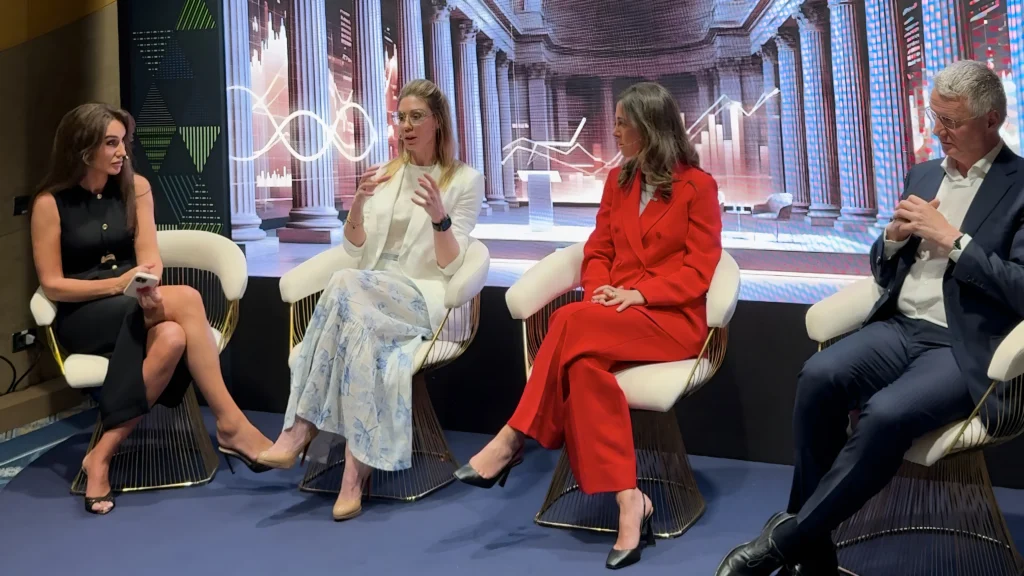
Noor Sweid’s clearest lesson about scale did not come from theory, it came from taking her family business public in 2008.
As Founder and Managing Partner of Global Ventures, Sweid recalled one of the landmark listings of that period: the first company from the MENA region ever to list on the LSE, and the first simultaneous listing on the LSE and NASDAQ Dubai. The company raised $500 million, with Morgan Stanley and UBS as bookrunners, and generated $600 million in revenue that year.
Five months later, Lehman Brothers filed for bankruptcy. The share price fell 70% and never really recovered.
“Share price is much more driven by market sentiment than underlying company performance,” Sweid reflected. “I’m personally jaded.”
It was one of many truly honest moments of the day. The FII PRIORITY Europe Summit had spent hours discussing why Europe still struggles to produce decacorns, why its best companies list in New York, and why capital does not cycle back into early-stage funds. Sweid’s story, almost 20 years old, was a reminder that the system does not always reward the right things, and that liquidity accelerates everything, including risks no one is watching.
Not a startup problem, a scaling problem
Not enough venture capital, too much regulation, founders thinking too small: this sounds familiar to every European entrepreneur. Hani Enaya, Chief Investment Officer at Sanabil Investments, was clear: “Europe does not have a startup problem. Europe has super-talented founders, amazing startups. The problem is scaling up and the lack of a growth ecosystem: access to deep pockets, to massive markets, and to a unified regulatory framework. It is easier to scale up from Los Angeles to Dallas than from London to Berlin.”
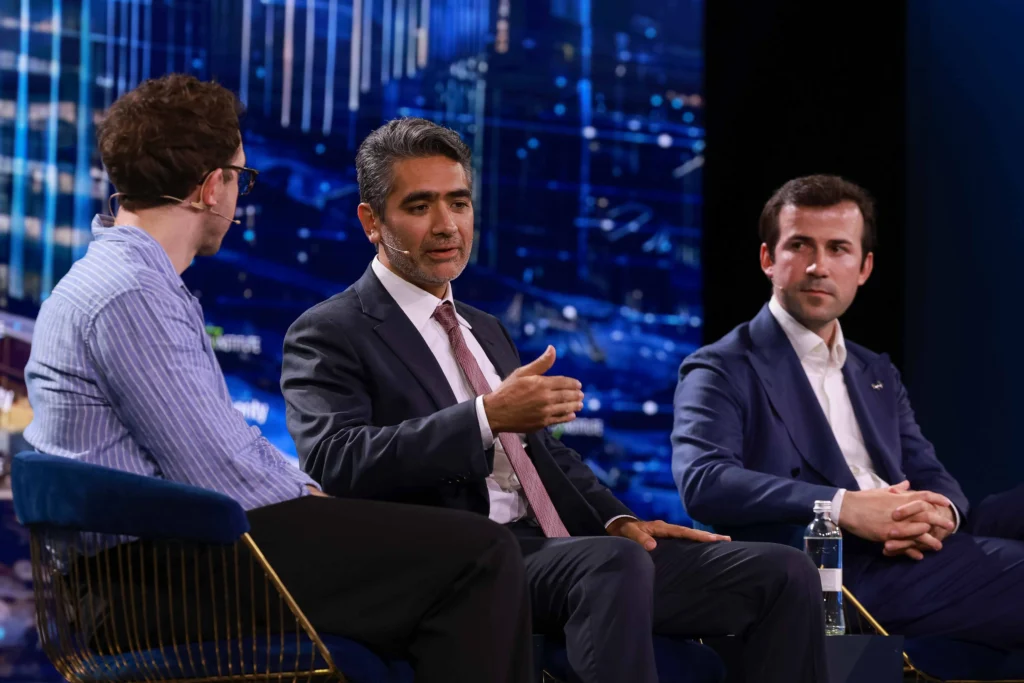
European deep-tech startups raised approximately $20.3 billion in 2025, nearly one-third of all European venture capital, according to Dr. Ahmed Ismail, co-founder of Dunia Innovations, writing in the FII Institute’s essay series. Paris-based Mistral closed a €1.7 billion Series C at an €11.7 billion valuation. Munich-based Helsing raised €600 million at a €12 billion valuation. French unicorns have soared from seven in 2015 to 42 in 2024. So the capital problem, at the early stages, is not as acute as the scaling problem.
The political will is there. What comes next?
Reflecting on what it takes to turn a domestic champion into a globally competitive company in Europe, Italy’s Minister of Enterprise and Made in Italy, H.E. Adolfo Urso, made the government case for structural reform while opening the “From Unicorns to Decacorns” panel.
Urso believes Europe needs a single market on the scale of the United States or China. The 28th regime, a European Commission proposal published in March that would allow a founder to incorporate once and operate seamlessly across 27 member states, would enable startups to register at the European level in 48 hours, then scale and grow.
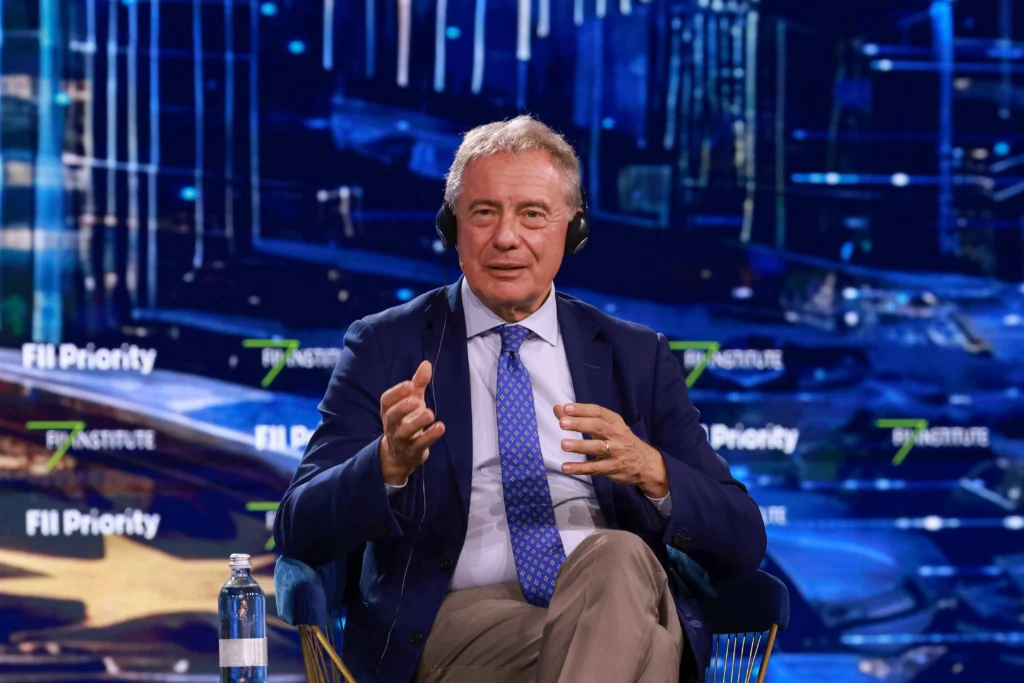
Urso pointed to the host country as proof of concept: “The AI factory in Bologna is a model example. We have implemented three supercomputers in Bologna, Genoa and Pavia, among the first ten in the world. Data centers are obviously the goal to fuel everything: only in the last ten days, we have certified three investments in data centers with a value of €10 billion.”
So the political will seems clear. The next test is whether Europe can build the infrastructure needed to absorb that investment at pace.
The 100-ticker solution: if you’re not an AI company, you have no chance
Uljan Sharka, Albanian-born Founder and CEO of Domyn, an Italian AI startup developing AI models and agents for enterprise as well as its own AI infrastructure, shared a provocative view on the economics of building AI at scale. The company is planning to raise €10 billion over the next few quarters.
“If you make the simple statement that producing AI is cheap compared to these big numbers, you make it more accessible for every country to own it,” Sharka said. The trillion-dollar figures associated with US AI are largely about distribution to hundreds of millions of users, not about training the models themselves. For governments, banks, and regulated industries, where sovereign control matters more than market share, that reframes what is actually required.
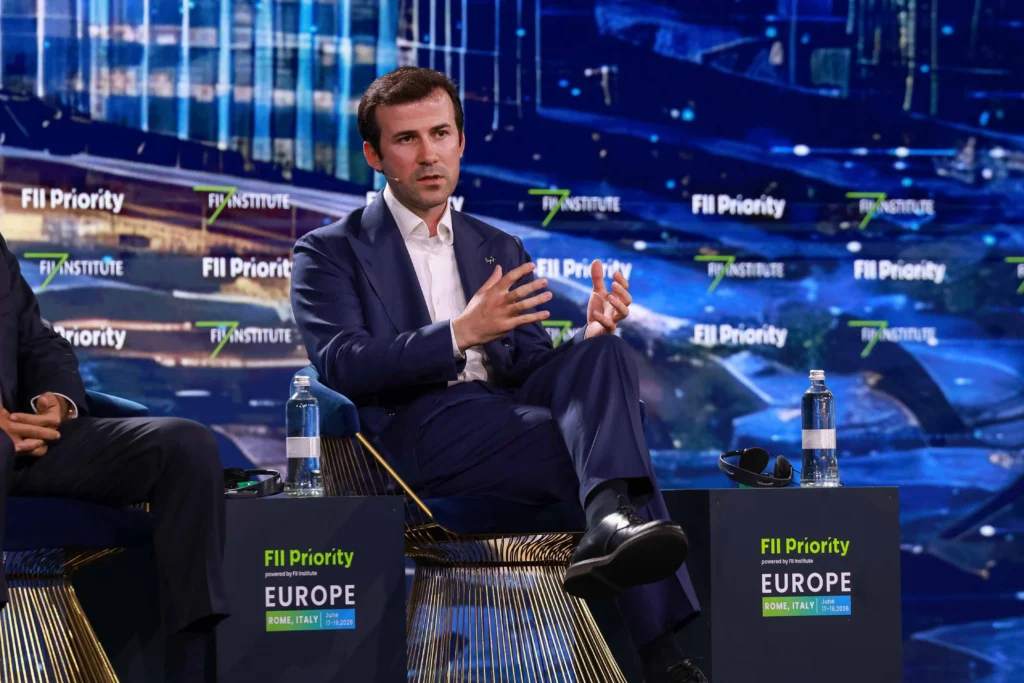
On public markets, Sharka noted: “It’s not about governments unifying capital markets. It’s about how we drive our champions in every industry to become AI companies so they can compete in a market where AI has become central. We need car makers to 50x their valuation by becoming AI car makers, not car makers that use AI.”
His proposal was concrete: take the first 100 listed European companies and help them make the transition to AI-native. “Money goes where growth is. If we create that level of growth in a market that is absolutely undervalued, the capital markets will come together naturally.”
Gulf partners have a role to play, he added, because “they have the courage to unlock capital” and trigger the domino effect.
The kicker Sharka offered leaves Europe with no alternative: “If we want comparable IPO markets, we need comparable companies. If we want comparable companies, we have to accept that every company needs to become an AI company, no matter what industry.”
Act or wait?
Reflecting on what is crucial for the awakening of European capital markets, Olivier Bélorgey, Deputy CEO and CFO of Crédit Agricole Corporate & Investment Bank, made a point that might sound abstract but is not: “Finance sovereignty is the primary sovereignty: without sovereignty in finance, you do not have the means and the power to finance any other form of sovereignty.”
He was talking about the EU’s Savings and Investment Union, the push to mobilize the roughly €10 trillion in European household savings currently sitting in bank deposits. But the logic extends beyond monetary policy.
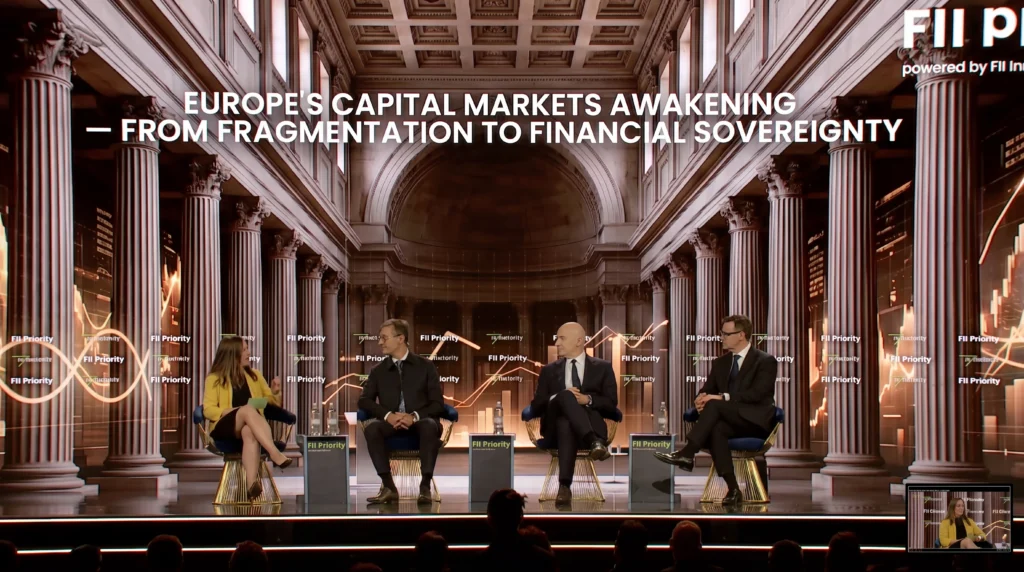
Stephen Dainton, Chief Client Officer at Barclays, put numbers to the structural gap: the US asset-backed securities market runs to roughly $12 trillion, compared with Europe’s $1.3 trillion. It is one of the mechanisms behind America’s ability to fund companies at a pace Europe has not matched.
Andrew Cohen, Executive Chairman of J.P. Morgan’s Global Private Bank, added more context. Of roughly 1,600 unicorn companies globally, many are European, so creating them is clearly not the problem. Cohen also pointed to one number that cut through: the year’s largest defense IPO was in the Czech Republic and was oversubscribed in four minutes. “Capital will flow from all over the world,” he said, “so we just need to give it somewhere to go.”
On whether any of this changes through gradual policy progress or requires a more dramatic intervention, Dainton was categorical: “You have to act. We’re in an industrial revolution around many sectors that has a deep requirement for capital.”
Beyond the big names: where the money actually goes
The venture capital panel, moderated by Bloomberg’s Natalia Kniazhevich, spent less time on the big names and more on what actually determines where capital flows.
Isabelle Freidheim of Athena Capital pointed to the category most investors overlook: the hundreds of thousands of smaller, faster-growing companies servicing the AI industry, along with legacy businesses using AI to accelerate what they already do. This is where she sees the real value creation happening right now. She flagged two government investment themes worth tracking separately: funding early innovation, and backing scale and infrastructure, including defense, data centers, and energy.
Noor Sweid’s view on the current moment was sharp: “We’ve seen this bifurcation, the big companies, big VC funds, the big everything getting 80 or 90% of capital, and everybody else being left behind. That’s stifling innovation.”
Her proposed fix: the wave of large IPOs expected in 2026 generates distributions to limited partners, who then recycle capital into smaller funds. The innovation boom has to pass through the public markets first.
A detail from her own portfolio made the European angle concrete: more than a dozen of Global Ventures’ companies now generate more revenue in Europe than in their home markets. So the solution could be to prove the model somewhere with high adoption and no incumbents, then enter Europe, where established players, having watched it work elsewhere, are finally willing to buy.
Graziano Seghezzi of Sofinnova, which has €4 billion under management across biopharma and biotech, corrected the idea that IPOs signal success or failure: “We don’t look at an IPO as an exit. We look at it as a financing and as a building block.” Healthcare companies burn €100 million to €150 million a year before generating returns. Public markets are what keep them alive.
Sharper vision, sooner action
The sessions are over, but the structural problems remain. Ten billion euros in Italian data centers. A pan-European company law that may or may not pass by 2027. Billions in household savings that are not yet in capital markets. Universities trying to do what the private sector already does faster.
Day 1 allowed for a sharper view of where the blockages actually are. The easy version of this conversation blames excessive European regulation and leaves it there. What Rome kept returning to was more specific: the absence of industrial first buyers willing to take a risk on unproven technology, an asset-backed market one-tenth the size of the US equivalent, a talent culture that still treats moving from a university to a startup and back as exceptional rather than routine, and a persistent gap between Series B and Series C.
The diagnosis is clear, but the cure is yet to come. Building the ecosystem, including the first buyers, the fluid talent, and the exit markets, is the work Europe still has ahead.