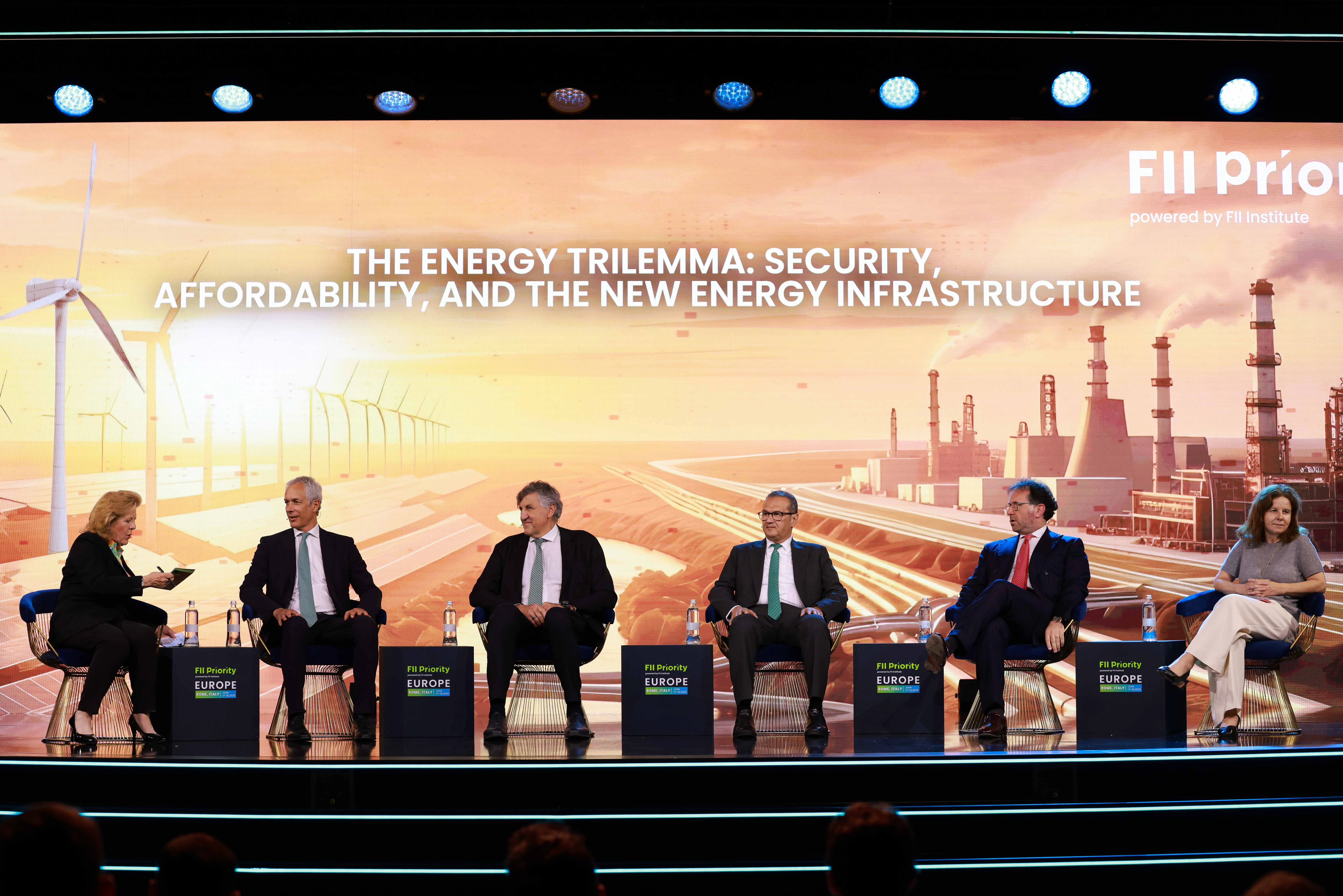
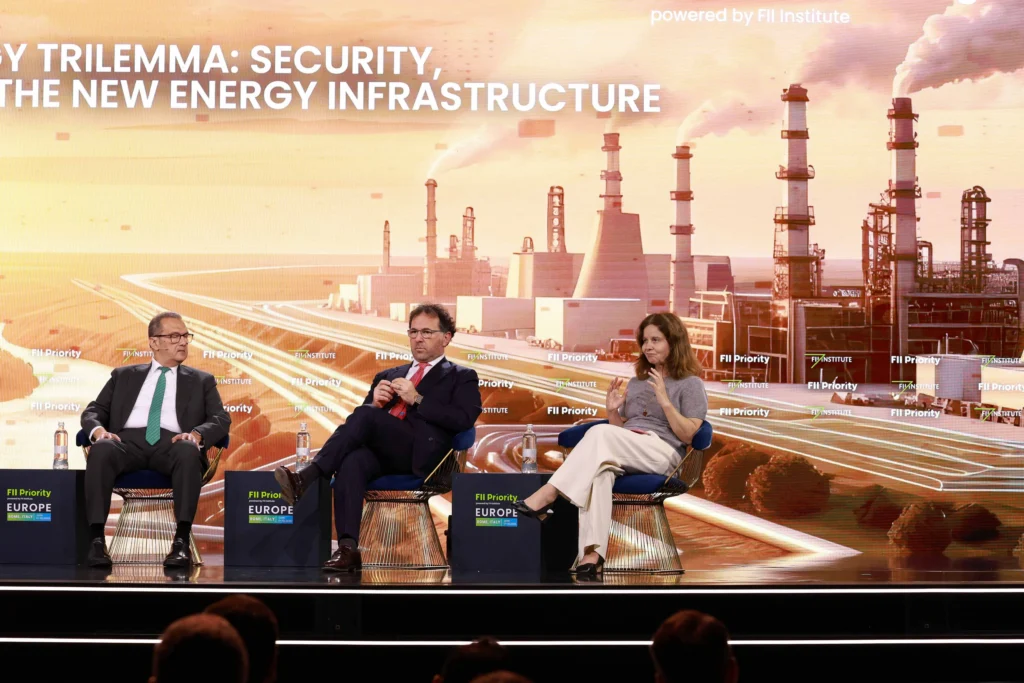
The global energy transition is no longer defined by a simple trilemma of security, affordability, and decarbonization. As multiple speakers at the FII Priority Europe sessions argued, it has evolved into something more complex: a quadrilemma shaped by geopolitics, infrastructure speed, industrial strategy, and strategic positioning in global value chains.
At its core lies a fundamental tension: while capital is accelerating into digital and AI infrastructure, the physical systems that make that transformation possible, including energy networks, fuels, and critical minerals, are struggling to keep pace.
A world moving at different speeds
Marco Arcelli, Advisor to the Chairman and former CEO of ACWA, described a fragmented global race in which the decisive factor is no longer only technology or cost, but speed.
China is “really powering ahead” with state-led deployment of green molecules such as hydrogen and ammonia; the US benefits from abundant energy and demand; and India is scaling rapidly. By contrast, “Europe is standing still,” constrained by slow decision-making and demographics.
He framed the key 2026 choice as whether Europe continues to “fight the emergency” or builds a “structural advantage” based on renewable molecules. Recent shocks, including COVID, Ukraine, and the Middle East, exposed fossil fuel vulnerability, while renewables offer “stability” and predictable costs because “you invest, it’s there forever,” potentially reducing import dependence and strengthening industry.
Nuclear returns as a circular system
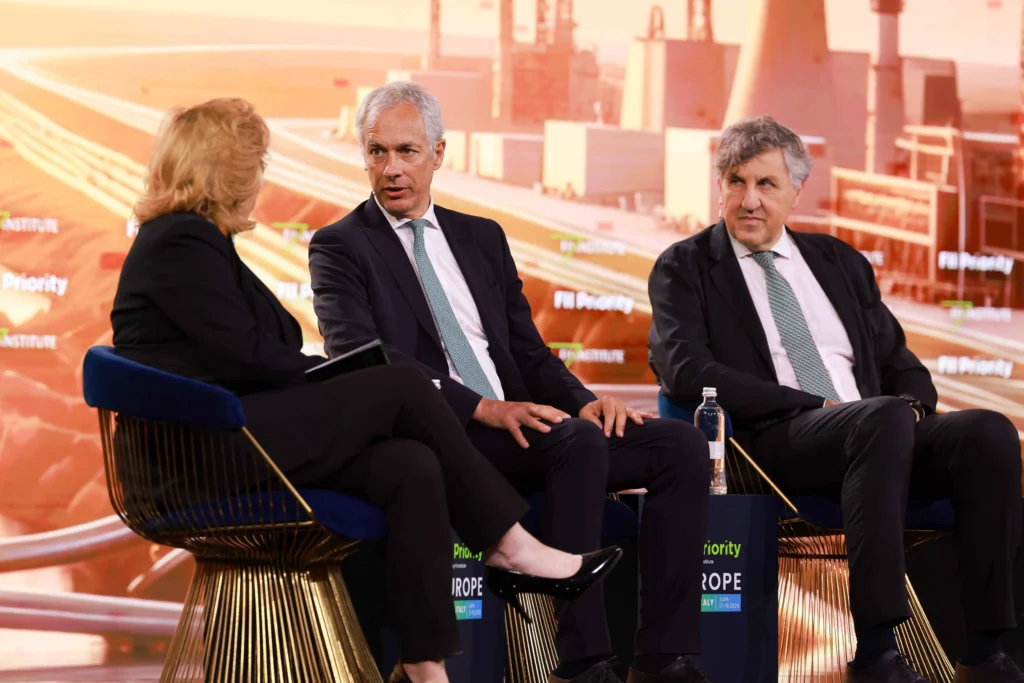
If green molecules represent one pillar of future energy systems, nuclear is re-emerging as another. Stefano Buono, Founder and CEO of newcleo, argued that Europe is reopening the long-closed debate on nuclear fuel recycling after decades of reluctance. Spent nuclear fuel is no longer waste, but a potential resource that could significantly extend Europe’s energy supply if reprocessed through advanced nuclear technologies. As he put it, “we are paying for 40 years in which industry was blocked.”
Buono said Europe “has an incredible opportunity” and stressed that “we have an asset actually in Europe that can provide energy for hundreds of years.” Only 0.5% of the energy contained in uranium has been used so far, meaning “we can still extract 200 times the energy that we have,” fundamentally reframing nuclear waste as a vast, untapped energy reserve.
Gas exploration: the missing stabilizer
Despite their different technologies, speakers converged on a shared diagnosis: the system is structurally unbalanced. Dr. Mohamed Farouk of ADES Holding highlighted Europe’s dependence, noting that it is “importing 60% of its energy needs” and “97% of the oil needs,” driven by underinvestment and weak capital allocation.
Yet he stressed that “there’s still an opportunity,” calling for more gas exploration in the Mediterranean, Black Sea, and North Sea. Combined with renewables, he argued, this would restore balance to Europe’s energy mix and reduce systemic volatility.
Infrastructure: the real bottleneck is execution
Doris Honold, Board Member of Voluntary Carbon Market VCM and Vice-Chair of the German state-owned energy company SEFE, argued that the EU already has the tools, including carbon markets, savings, and the emerging grid package, but lacks execution.
Her example was stark: Germany built a floating LNG terminal in under six months, showing what political will can unlock. The real bottleneck, she said, is permitting, not engineering.
Europe, she noted, holds trillions in savings that could be used as potential capital, but it struggles to channel that money into infrastructure. The challenge is no longer ideas, but alignment and execution.
Critical minerals: the invisible foundation
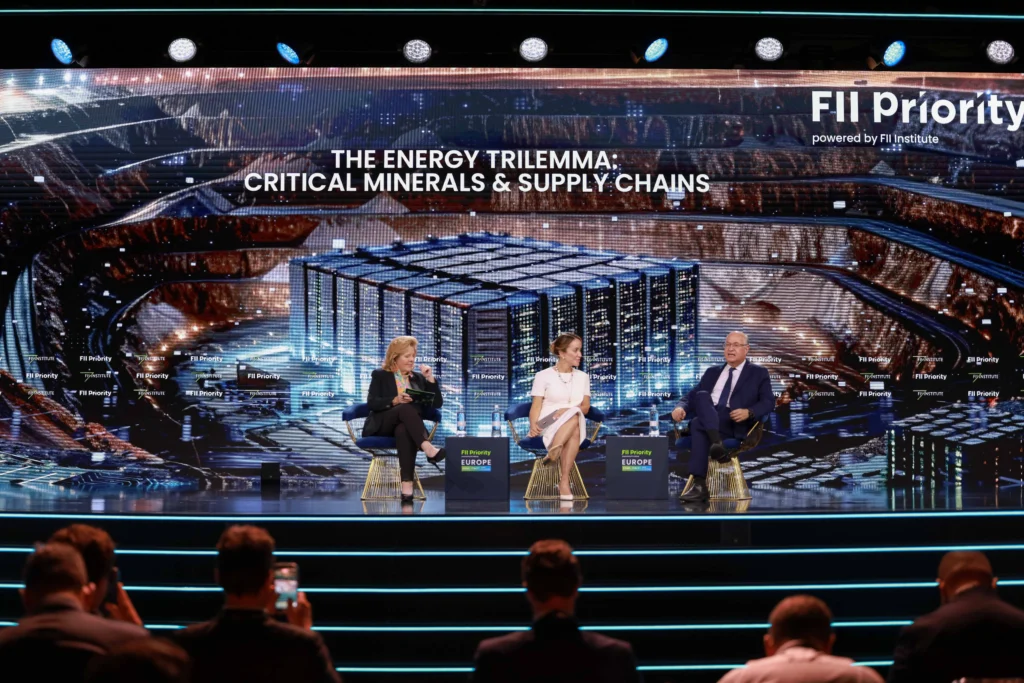
If energy infrastructure is the visible system, critical minerals form its invisible foundation. The Energy Trilemma: Critical Minerals & Supply Chains session at FII Priority Europe underscored the need to rethink how resource-rich and consuming regions work together.
Ilan Goldfajn, President of the Inter-American Development Bank, highlighted that Latin America holds “40% of the world’s critical minerals,” positioning it as a strategic global supplier. However, he warned that the traditional model of simple extraction must evolve. To ensure safe and resilient supply chains, regions supplying the minerals must see value-added opportunities and job creation beyond extraction. He noted that without this domestic economic benefit, disparities between regions grow, making it increasingly difficult to build secure global networks.
Goldfajn reinforced the financing dimension, noting that the IDB already has a “$4-5 billion pipeline” in mineral and infrastructure projects aimed at mobilizing both public and private capital. Development banks, in this view, are becoming connectors between geopolitical blocs and financial systems.
Ana Cabral, CEO of Sigma Lithium, introduced the concept of the “holy triangle” necessary for a successful supply chain: large-scale low cost, traceability, and sustainability. These are essential foundations for batteries, electrification, and the wider digital transition.
Her message was clear and pragmatic: Europe cannot secure critical minerals in isolation. It must deepen integration with regions like Latin America, allowing early-stage industrialization abroad while maintaining strict sustainability standards. The alternative is stagnation because, as she put it, “if you never build, you never start.”