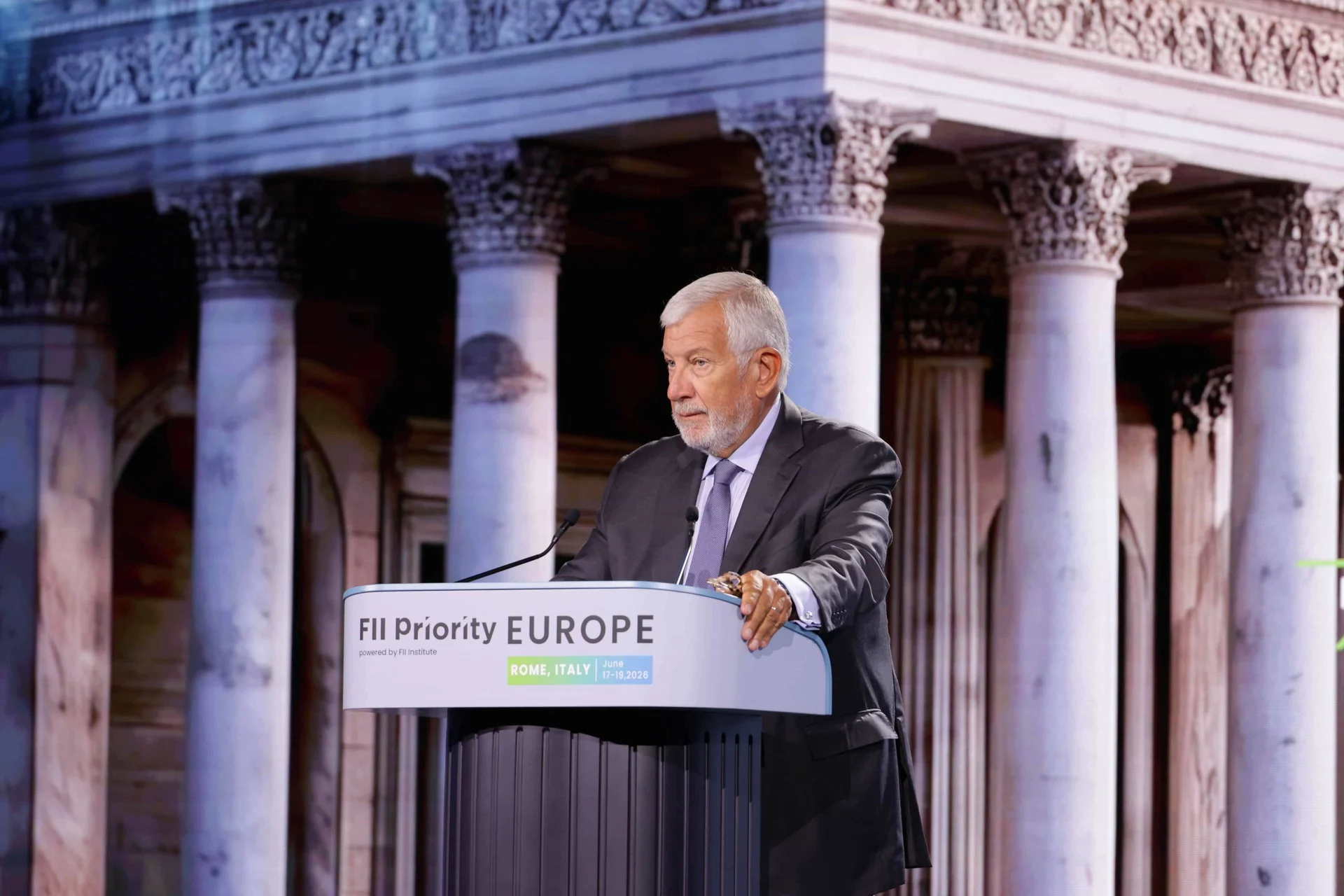
Italy, a G7 economy, now has a lower GDP per capita than Mississippi. That single line, dropped midway through a panel on FII PRIORITY Europe’s first full day, did more to frame the morning than anything said before it. Richard Attias had opened by naming the narrative everyone in the room had come to challenge: that Europe is too slow and too regulated.
Prime Minister Giorgia Meloni, in a recorded message, and Rome Mayor Roberto Gualtieri each made the case for optimism in their own way: Rome as the city where the European project began in 1957, and Rome as a city now betting €240 billion over twenty years on becoming a quantum-computing and AI hub.
A test case in real time: What happens after the shock eases
The Strait of Hormuz had been the year’s defining flashpoint: a blockade threat that hit energy markets first, then rippled through petrochemicals, fertilizer, and advanced semiconductor manufacturing. By the time FII PRIORITY Europe opened, an MOU had just been signed to resolve the crisis, and the room spent its first hours testing what that actually meant. H.E. Yasir O. Al-Rumayyan, Governor of Saudi Arabia’s Public Investment Fund, offered the long view: Saudi Arabia’s hedge against exactly this kind of disruption dates back decades, to an east-west pipeline built after a similar threat in the 1980s. It has since been expanded from 5.5 million to 7 million barrels of daily capacity, with storage reserves the Kingdom is now looking to increase further.
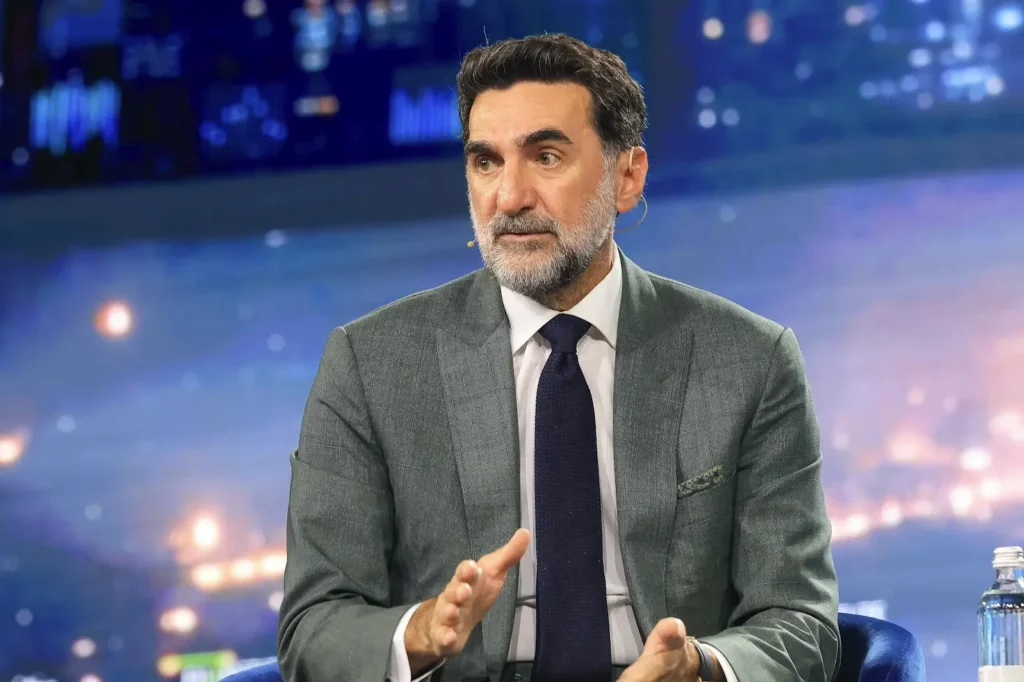
Later that morning, Sir Noel Quinn of Julius Baer offered a more cautious reading of the same news.
“I think we all read the sigh of relief that there has been a settlement, but will the signing of that alone create the confidence needed to initiate investment? I think time will have to pass for that confidence to build.”
Andrea Orcel of UniCredit agreed that the worst had likely passed, but noted that most European businesses had already weathered a comparable shock with Russia’s invasion of Ukraine. This time, he said, they were better prepared: hedged, resourced, and ready to absorb the hit rather than panic through it.
Asked what the episode meant for Europe specifically, Al-Rumayyan put a number on it: roughly €98 billion deployed by PIF across Europe and the UK since 2017, generating an estimated €70 billion in GDP contribution and 160,000 jobs. Aramco alone has spent €8 billion with European suppliers, a quarter of it in Italy.
PIF’s newly approved strategy through 2030 will keep deploying capital internationally, he said, even as a larger share of total investment shifts toward six domestic ecosystems anchored by NEOM. On energy itself, his message was blunt: what the world needs now is “energy realism,” not a contest between fossil fuels and renewables. AI-driven demand growth, he argued, makes oil and gas anything but optional. The one friction point he raised unprompted was regulation: rules that, in his telling, are making it harder for investors like PIF, Aramco, and SABIC not only to invest more in Europe, but to hold on to what they have already built there.

The reckoning
The Board of Changemakers panel was billed as a debate over whether Europe sits at an inflection point or the edge of a cliff. Instead, it produced a string of numbers that made the case on their own. Sir Noel Quinn, Chair of Julius Baer, went first: 85% of US private R&D flows into high-tech sectors, while in Europe, half of all R&D spending still goes into traditional industry. Total R&D investment stands at €403 billion in Europe, against €780 billion in the US. China filed 1.8 million patents in 2024, the US filed 600,000, and Europe filed 200,000. Venture capital funding came to €52 billion in Europe versus €138 billion in the US, most of it aimed at high tech.
“That for me is the definition of an inflection point,” Quinn said. “Europe has a tremendous vision. It has great strategies. But it lacks agility to execute.”
Andrea Orcel, CEO of UniCredit, underlined that in 2011, Europe and the US held the same share of global GDP, around 21%. Today, the US stands at 25%, Europe has fallen to 17%, and China has climbed from 10% to 17%. European GDP per capita is now half that of the US, and Italy’s, specifically, trails Mississippi’s. The cause, Orcel argued, is not a shortage of ambition but a refusal to execute: more than a quarter of European companies now have over 10% of their headcount tied up in regulatory compliance alone.
Anthony Gutman of Goldman Sachs pushed back against the gloom. Europe, he said, is on the cusp of “an incredible investment supercycle,” driven by AI infrastructure, the power generation it will require, and a wave of cross-border consolidation that has already pushed European M&A activity up roughly 60%. Stella Li of BYD brought the argument down to ground level: her company already manufactures in Hungary, but electricity costs are now the single biggest factor in where BYD builds next. Power costs 20 to 40 cents per kilowatt-hour in Germany and can peak near 60 cents in the UK, compared with roughly 6 cents in Saudi Arabia and the UAE. Spain and Italy remain on the company’s shortlist; Eastern Europe, she said, is competitive but too small a market to anchor a major facility on its own.
The Draghi Report, mostly still on the shelf
Moderator Manus Cranny opened the next session by sizing up the document everyone in the room kept invoking: the Draghi Report, 400 pages and 176 measures. Sergio Dompé of Dompé Farmaceutici, who contributed to it, turned that scale into a specific complaint. Europe’s share of global patent filings has dropped 32.5% over the past fifteen years, he said, while China’s rose 40% and America’s 6%, leaving the US at 34% of global filings today, China at 30%, and Europe at roughly 20%. His own company’s most recent regulatory recognition, he noted, came from the US Food and Drug Administration, not from any European authority. Asked directly how much of the Draghi Report has actually been put into practice, Dompé did not soften it: about 10%.
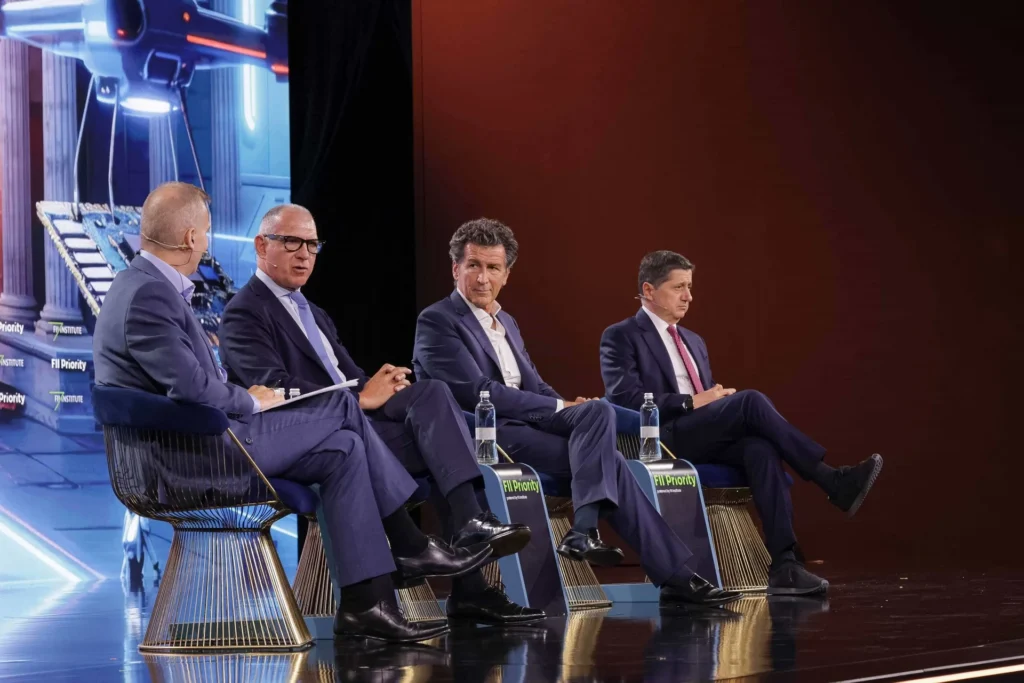
Maurizio Tamagnini of FSI named the capital problem sitting underneath all of it: roughly €300 billion in European savings leaves the continent every year, much of it bound for the US, while pension allocations to alternative assets sit at 3% to 5% in continental Europe, compared with close to 50% in Sweden and Canada. Andrea Pignataro of ION Group offered the session’s clearest note of optimism. Europe, he argued, does not need to invent the next technology wave; it needs to adopt it quickly, the way it did in the 1950s, when the continent grew at 4.5% a year by absorbing American management techniques rather than inventing its own.
“It doesn’t matter if the technology has been invented elsewhere. It is a huge opportunity for Europe.”
The OECD had just cut its 2026 eurozone growth forecast to 0.8%, a downgrade Eleni Giokos flagged at the top of the Board of Changemakers panel and one that hung over every session afterward without anyone needing to repeat it. By midday, the room had heard real ambition and a fair amount of real money already in motion. It had also heard, in unusually plain numbers, why that growth figure keeps sliding, along with a rough sketch, from three very different speakers, of what it would actually take to stop it.