Over the past few years, sovereignty has become one of the defining ideas in artificial intelligence.
Countries are investing in sovereign clouds, sovereign compute, sovereign models, and sovereign chips. The ambition is understandable: AI is becoming foundational infrastructure, shaping competitiveness, security, productivity, and public services.
But there is a paradox at the heart of the sovereignty agenda. As Joséphine Kant, Head of Ventures at the Sovereign AI unit of the UK government, put it: the technologies countries seek to control are “the most globally interdependent object that humanity might have ever created”.

An AI model may be trained in one country, run on chips designed in another, manufactured elsewhere, powered by global energy markets, and deployed through infrastructure distributed across continents.
For Kant, this reality requires rethinking what sovereignty means.
“I’m really trying to get away from this idea of sovereignty as control, and I look at sovereignty as leverage.”
That idea was echoed in the call by Deemah AlYahya, Secretary-General of the Digital Cooperation Organization, to connect countries through their respective strengths.
“Every country has a competitive advantage. And by connecting these competitive advantages together, we can leapfrog faster and bridge that AI divide quicker.”
Together, their arguments point toward a different vision for AI competitiveness: not owning every layer of the stack, but building strategic capabilities that allow countries to participate, influence, and collaborate from a position of strength.
Leverage, in this context, means creating conditions that attract talent, accelerate experimentation, and allow countries to become indispensable participants in global innovation networks rather than attempting to replicate entire ecosystems domestically.
Kant extended this argument into a broader idea of competitiveness based on attraction rather than protection.
“It’s not about telling founders you should build in this country because you’re from here. It’s about actually making it easier for them to do so.”
That same logic led David Moinina Sengeh, Chief Minister and Chief Innovation Officer of Sierra Leone, to challenge the assumption that every nation must build its own model.
“Sierra Leone does not need to invest billions to develop its own national model.”
Instead, he pointed to examples already showing how global AI technologies are creating local outcomes across education, healthcare, and energy deployment.

This shift in thinking extends beyond models and into infrastructure itself. Drawing lessons from recent conflicts and infrastructure risks, Sengeh raised the idea of data embassies and questioned whether concentrating critical data in one place creates vulnerability.
“We’ve seen in the world if all of your data is in one location and it’s bombed and you’re trying to protect it, that’s it.”
Instead, Sengeh proposed a more distributed and cooperative approach.
“What does it look like to have data embassies across the world that are shared and protected?”
In his view, these are conversations governments need to be having now.
The debate over how infrastructure should be distributed is closely linked to another, more immediate tension: how regulation shapes the speed at which innovation reaches the physical world.
As Travis Kalanick, CEO of Atoms, argued, the challenge is not only what we build, but how quickly societies allow it to be deployed.
“The problem is when you get too caught up in the process versus the outcome. Then something that’s good for people rolls out a decade late.”

He pointed to autonomous driving as an example of this tension, where technologies can exist and mature elsewhere, yet take years to become accessible in certain jurisdictions—raising questions about whether delayed adoption ultimately serves citizens’ interests, especially when the stated goal is safety and public benefit.
The Real AI Revolution: Building the Physical World
While governments are still building the networks required to scale AI, a more fundamental revolution is already unfolding.
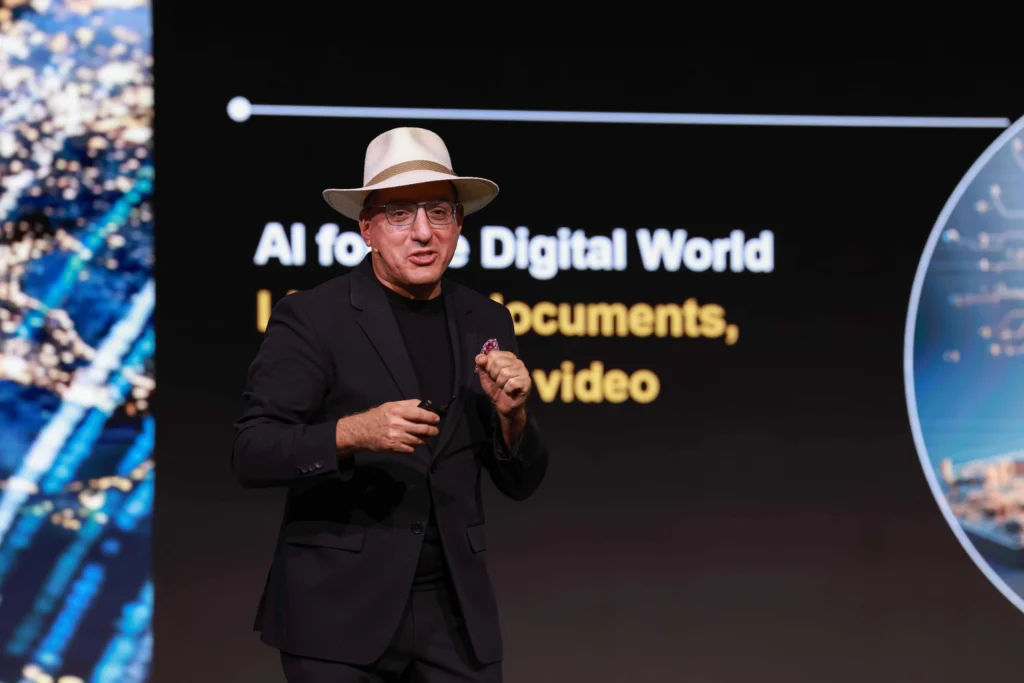
According to Jack Hidary, CEO of SandboxAQ and author of AI or Die, the next major transformation may come not from language models alone but from Large Quantitative Models (LQMs).
As he explained:
“We know that LLMs are affecting each vertical: we can use it to make documents, we can make videos. But how about the actual real economy, when we want to make a new medicine for cancer or Alzheimer’s, or design a new kind of plane that maybe is 10% lighter and more fuel-efficient, or when we want to defend our countries with defense and national security — chemicals, energy? All this is not really a job for the LLMs — it’s a job for the LQMs: Large Quantitative Models.”
These systems aim to solve real-world constraints: discovering new battery chemistries, accelerating drug development, designing catalysts, improving semiconductor production, and optimizing energy systems.
For Hidary, the distinction between language and quantitative systems reflects a broader shift in where AI creates value.
“We need to combine the LLM with the Large quantitative models. This is the revolution now that really will impact our daily lives for the drugs that we need, for the semiconductors that we need, for the batteries that we need…”
The potential applications are extraordinary, and the transformation is only just beginning.
“I’m very proud to announce here today that we’ve secured a $500 million warrant from the United States government from the CHIPS act… to transform semiconductor manufacturing through AI-driven material discovery”.
Hidary also cited the example of Nobel Prize winner Dr Stanley Prusiner and the application of Sandbox technology in advancing research on Alzheimer’s and Parkinson’s.
“He used our software saving literally years and years of work that otherwise he’d have to do and most likely would lead to failure”.
So to answer the question that also titled one of the top-level panels at FII Priority Europe 2026—Can AI turn physics into the biggest investment opportunity of the decade?—the answer is yes.
As AI moves beyond language into physics, materials, energy systems and industrial processes, it turns real-world constraints into something increasingly computable, optimizable and scalable.
And in that world, physics is no longer just something to understand. It becomes something to build from — and, like the sovereignty Kant described, something no single country can fully own.