EUROPE’S ECONOMIC FUTURE IS OFTEN discussed through the lenses of defense, energy security and industrial policy. Yet one of its most consequential vulnerabilities sits elsewhere: in food systems.
In particular, the evolving agricultural interdependence between the European Union and South America will play a growing role in determining whether Europe becomes more economically resilient—or more exposed.
As geopolitical fragmentation intensifies and climate shocks become more frequent, the European growth model built on efficiency, globalized supply chains and cost minimization is under strain. The assumption that optimization always triumphs redundancy is being reconsidered.
What is emerging instead is a doctrine of “managed interdependence”: selective openness in strategically critical systems such as energy, critical minerals and food. Food systems belong firmly in this category.
EUROPE’S HIDDEN DEPENDENCY
Europe is often described as food secure. On a caloric basis, this is broadly correct. The EU’s agricultural base, supported by the Common Agricultural Policy, remains highly productive. But this headline obscures a more structural dependence on imported inputs that are essential to modern European diets.
The most important of these is protein. Europe’s livestock sector is heavily reliant on imported soymeal, much of it sourced from South America. Other dependencies include coffee, cocoa, fruit, and fertilizer inputs linked to global energy markets. In drought years, Europe also relies on imported grains to stabilize supply.
This creates a paradox: Europe is self-sufficient in many agricultural outputs, but dependent in the systems that sustain them. The vulnerability is not outright shortages, but price volatility, input shocks, and cascading supply chain stress. In other words, Europe’s food security risk is financial and systemic, not existential.
FROM EFFICIENCY TO RESILIENCE
For three decades, Europe’s economic model prioritized efficiency through global integration. Supply chains were optimized for cost; food systems were treated as largely apolitical; and dependence on external suppliers was not seen as a strategic concern. That assumption no longer holds.
Climate volatility, geopolitical fragmentation and input scarcity are reshaping agricultural markets. Fertilizer prices are increasingly tied to energy shocks. Extreme weather is affecting yields across continents. Export restrictions have reappeared as a policy tool in multiple regions.
Against this backdrop, Europe’s strategic question is no longer whether globalization works—but what kind of globalization is sustainable under stress.
SOUTH AMERICA AS A STRUCTURAL COUNTERWEIGHT
Nowhere is this question more visible than in Europe’s relationship with South America, particularly Brazil and Argentina within the broader Mercosur bloc.
South America is not simply a supplier of agricultural commodities. It is one of the few regions with the land base, productivity potential and climatic complementarity to stabilize global protein and feed markets at scale. With productivity a much-misunderstood feature, one that is not an accident of abundance but a 50-year journey of science and technology. Five times productivity with only twice the land use through Agrotech.
Brazil and Argentina, alongside Uruguay and Paraguay in the Mercosur bloc, play a central role in global soy, beef and corn exports. These flows underpin Europe’s livestock sector, particularly poultry, pork and dairy production.
At the same time, Europe represents a stable, high-value demand center with regulatory sophistication and long-term purchasing power. The relationship is therefore not one-directional dependence, but mutual structural coupling: South American producers rely on European market access and pricing stability, while Europe relies on South American output to stabilize its protein system. This interdependence is likely to deepen rather than diminish.
THE EU–MERCOSUR AGREEMENT: MISUNDERSTOOD DEBATE
The long-delayed EU–Mercosur agreement is often framed as a conventional trade dispute, particularly over agriculture and environmental standards. This framing is too narrow.
At its core, the agreement is about whether Europe and South America can build a rules-based food and agricultural corridor under conditions of climate stress.
Critics in Europe point to deforestation risks in the Amazon and Cerrado, regulatory asymmetries in pesticide use and animal welfare standards, and the political sensitivity of exposing domestic farmers to additional competition.
In South America, concerns run in the opposite direction: that European “green conditionality” functions as disguised protectionism, that value addition remains concentrated in Europe, and that environmental requirements are imposed asymmetrically on exporters rather than jointly governed.
These tensions are real. But they obscure the larger structural issue: the two regions are already linked through food systems that neither can fully decouple from without cost. The question is therefore not whether interdependence should exist, but how it is governed.
CLIMATE AS THE BINDING CONSTRAINT
Climate change is tightening this relationship. Europe is experiencing increasing drought stress in southern regions such as Spain and Italy, alongside growing rainfall volatility in northern agricultural zones. Soil degradation and water constraints are becoming structural constraints on yield stability.
South America faces parallel pressures. Shifts in rainfall patterns in the Amazon basin affect agricultural cycles further south. The expansion limits of the Cerrado are becoming more visible. Extreme weather variability is increasingly reflected in soy and corn yield volatility.
This creates a coupled system: climate shocks in one region increasingly transmit through trade flows into the other. Food security is therefore no longer a national or even regional variable—it is a transatlantic risk system.
TOWARDS A RESILIENCE-BASED AGRICULTURAL ARCHITECTURE
If the diagnosis is interdependence under stress, the policy response cannot be disengagement. It must be good governance not over governance.
For Europe, this implies reframing agricultural policy away from production maximization alone and towards resilience metrics: input diversification, soil health, carbon measurement, and supply chain redundancy.
The Common Agricultural Policy could evolve from a primarily subsidy-based system into a resilience framework that rewards climate-stable production and reduces dependency on single-source protein imports.
At the trade level, an EU–South America “food resilience corridor” could integrate logistics infrastructure, climate risk insurance mechanisms, and harmonized deforestation-free certification systems. The goal would not be to eliminate trade risk, but to make it more transparent, verifiable and jointly managed.
On the supply side, diversification of protein systems within Europe will also matter. Expansion of legume cultivation, development of alternative feed sources such as algae and insect protein, and advances in precision fermentation could all reduce systemic exposure to imported soy volatility over time. But none of these substitutes will eliminate the need for South American agricultural output. They will only rebalance the mix.
THE STRATEGIC REALITY
Europe’s economic resilience will not be determined solely in Brussels’ regulatory frameworks or Frankfurt’s monetary policy debates. It will also be shaped in the agricultural systems of the Pampas and Cerrado, the grain and dairy corridors of Germany, and France; in Europe’s own capacity to adapt its food model to a more constrained and volatile world.
The central strategic reality is straightforward: Europe’s food system is already structurally linked to South America. The question is whether this linkage remains ad hoc and politically contested or becomes deliberately governed as part of a broader resilience strategy.
The future of this relationship will not be defined by the logic of independence, but by the quality of interdependence. In an era of climate stress and geopolitical fragmentation, that distinction may prove decisive.
CO-AUTHORED BY
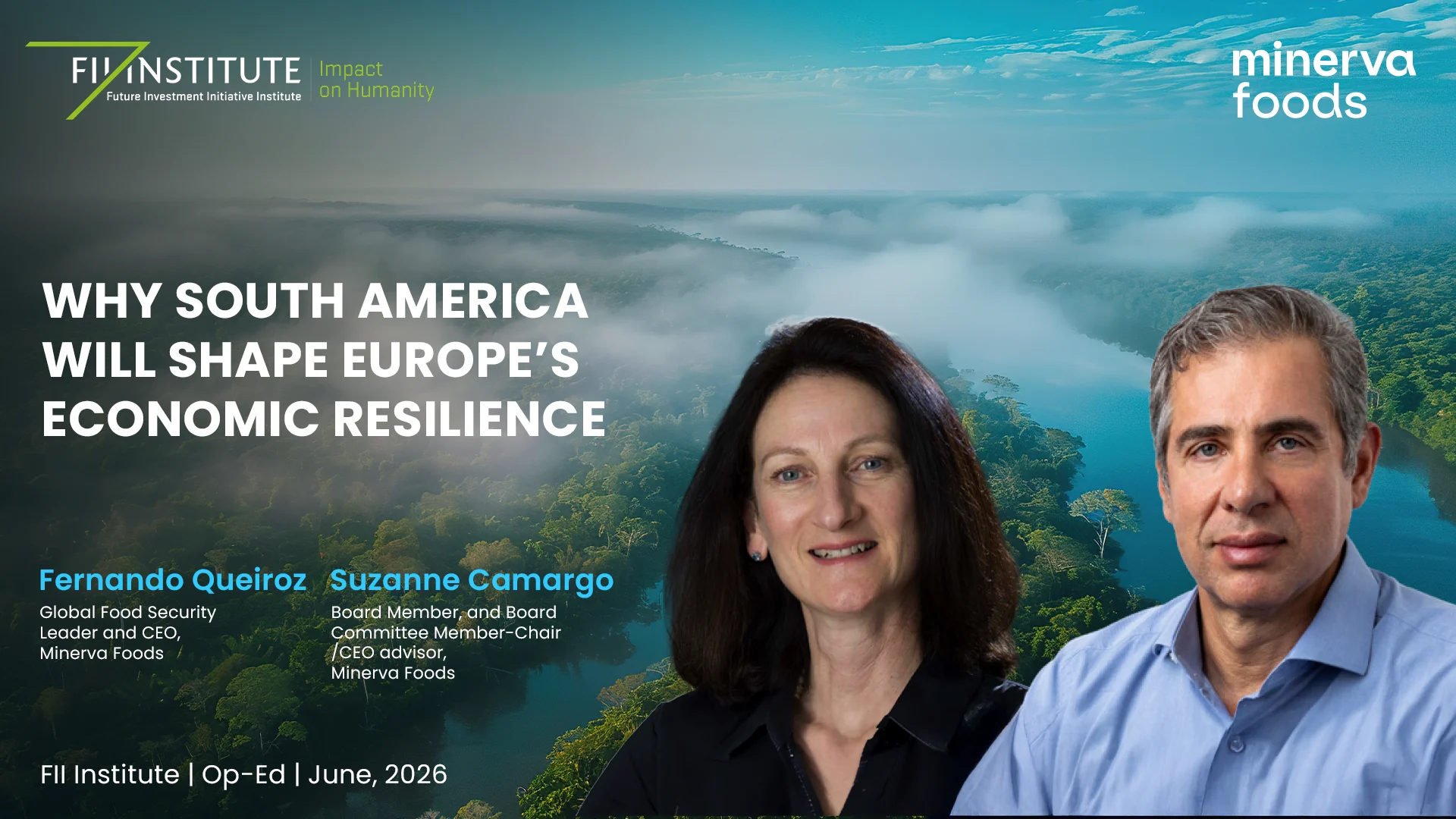
FERNANDO QUEIROZ, Global Food Security Leader and CEO of Minerva Foods, and SUZANNE CAMARGO, Strategist, Board Member, and Board Committee Member-Chair/CEO advisor Minerva Foods.