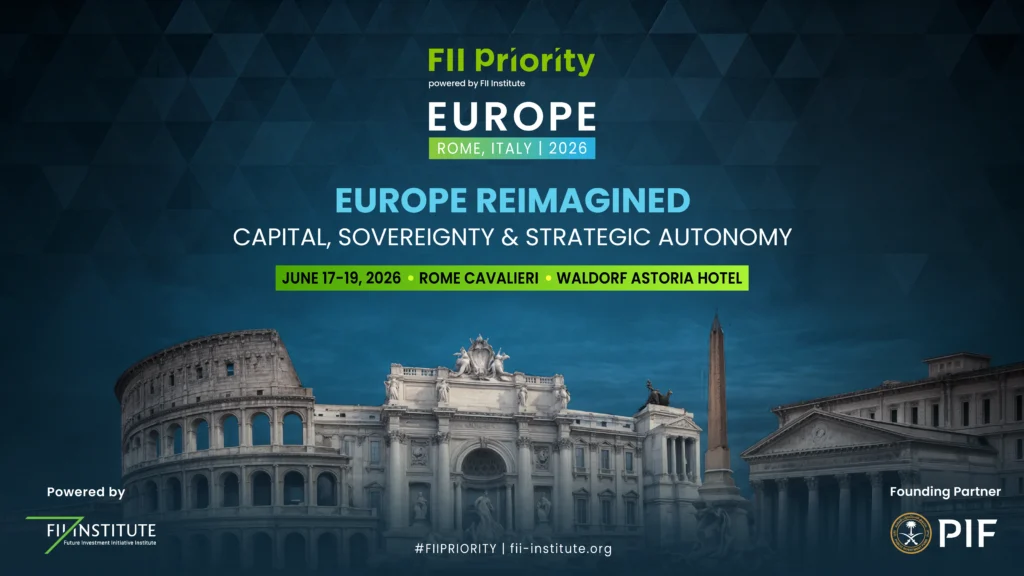
In just three days, global capital converges on Rome. Over 1,600 leading investors, policymakers and innovators from across the globe have registered to gather at a moment of acute uncertainty for Europe’s economic future, as well as acute opportunity. The FII PRIORITY Europe Summit, organised by the Future Investment Initiative (FII) Institute – a global non-profit foundation with an investment arm and one agenda, Impact on Humanity – opens on June 17 at the Rome Cavalieri, Waldorf Astoria Hotel.
Over three days of intense plenary debates, interactive panels, high-profile networking and hands-on labs — spanning green and digital transition, reindustrialisation, sovereign AI and shifting global capital flows — the Summit will generate ideas and commitments with a tangible bearing on the next stage of European growth.
The Summit will bring together high state representatives from Togo, Albania, Finland, Italy, Saudi Arabia and the United States, alongside former leaders from across Europe. Insights will be contributed and moderated by Columbia University, University College London, McKinsey and Oxford Science Enterprises, as well as Bloomberg, CNN, CNBC, The Financial Times, Reuters, Associated Press, Al Eqtisadiah, The National, Arab News, Sifted, RAI, Adnkronos and another 100 media reporters and outlets.
Stalled growth, geopolitical shock — and a continent at a crossroads
The European economy and prosperity have historically been the foundation of broader global security and growth. The second largest single economic bloc on earth, with a GDP of €25 trillion, has been built on predictability, transparency and the rule of law — features investors crave that stand in sharp contrast to political and geopolitical volatility elsewhere.
However, EU growth has effectively stalled. The OECD has cut its 2026 eurozone forecast to as little as 0.8%, citing the drag from global macroeconomic challenges and geopolitical shocks. By spring 2026, the European economy had begun to stagnate, facing rising energy costs, contracting business activity and constrained fiscal capacity. In Q1 2026, eurozone GDP was flat and inflation had risen to around 3%. Disrupted trade routes, reshaped global alliances, intensified superpower competition, and the transformative impact of AI and quantum computing are adding further pressure, driving a profound geoeconomic reordering.
Weak headline GDP growth, twin green and digital transitions, and rising security pressures collide in Europe with deep pools of capital still searching for productive deployment. The EU economy is now entering a new phase where it needs to refocus from crisis management to reimagining its strategic autonomy in energy, technology, security and finance, seeking new economic partnerships and sources of capital to remain competitive.
European businesses are already looking outward, capitalising on a global middle class projected to reach 5.3 billion by 2030 and an additional €20 trillion in new consumer spending worldwide. The pursuit of strategic autonomy in energy and technology has unlocked unprecedented capital commitments: Europe has pledged €1 trillion toward energy independence and clean energy leadership, and its energy transition initiatives alone represent a €3 trillion investment opportunity over the next decade.
So the question today is: what kind of growth agenda, institutional architecture and cross-border partnerships will allow Europe to remain a central pole of the global economy – and prevent it from gradually drifting to its periphery?
Italy: Third-largest EU economy and the strategic corridor into Europe
Italy is not merely the host. As Europe’s third-largest economy and a natural strategic corridor linking the Mediterranean, Africa and the Middle East to the wider European system, it sits at the centre of the supply-chain, energy and trade questions the Summit will address. Over €200 billion in Next Generation EU investment is already flowing through the Italian economy — making Rome a fitting venue for a conversation about where European capital goes next.
What Rome will debate this week: FII PRIORITY Summit as the nexus for leaders, capital and ideas
Against this backdrop, the Summit will address the most pressing questions facing investors, policymakers and innovators: how Europe shifts from a growth model that is no longer working to one built on strategic autonomy, powered by private capital deployed at scale into infrastructure, AI, energy and reindustrialisation. Leading global investors — among them PIF, Blackstone, Goldman Sachs, Wellington Management and Neuberger Berman — will be in the room.
Today, Europe’s stock market represents only 70–75% of GDP (compared to approximately 270% in the United States), capturing just a fraction of global venture capital. This creates a major opening for international investors to shape the next growth phase of a more connected, outward-facing Europe, with Italy’s role as a strategic corridor strengthening even further.
The scale of capital already in motion is striking. €800 billion in defence mobilisation, €750 billion in reindustrialisation funds and €200+ billion in EU recovery investment are reshaping where capital flows and what it builds. Tens of billions have already been committed to semiconductors through the European Chips Act; Europe has set a target of producing 40% of its clean-tech manufacturing domestically; and sovereign AI, energy security and defence industrial capacity are all attracting capital at a pace unimaginable five years ago.
This week in Rome, global and European leaders will move beyond diagnosis to prescription — examining how to finance reindustrialisation, build resilient supply chains and navigate the workforce transformation demanded by an AI-enabled economy that requires new skills and new social contracts in equal measure.
The Summit will close with a forward-looking panel “Europe 2030: A New Growth Story” featuring three former heads of state moderated by Richard Attias, Chairman of the Executive Committee and Acting CEO of FII Institute, asking the single question that has brought the world’s investment capital to Rome: what is the most important bet global investors should make on Europe today?
From this gathering, a concrete agenda to restore European competitiveness and reimagine the continent’s connections with global markets will begin to take shape — one with consequences that extend well beyond Rome.
Join the debates live here. The full program is available at fii-institute.org.