

Not innovation, but deployment. That was the challenge at the center of the Day 0 afternoon sessions at FII PRIORITY Miami.
Across four discussions, speakers examined what it takes to move from experimentation to real economic application: trusted enterprise systems, physical automation, energy capacity, and the potential expansion of infrastructure beyond Earth.
From AI capability to deployment reality
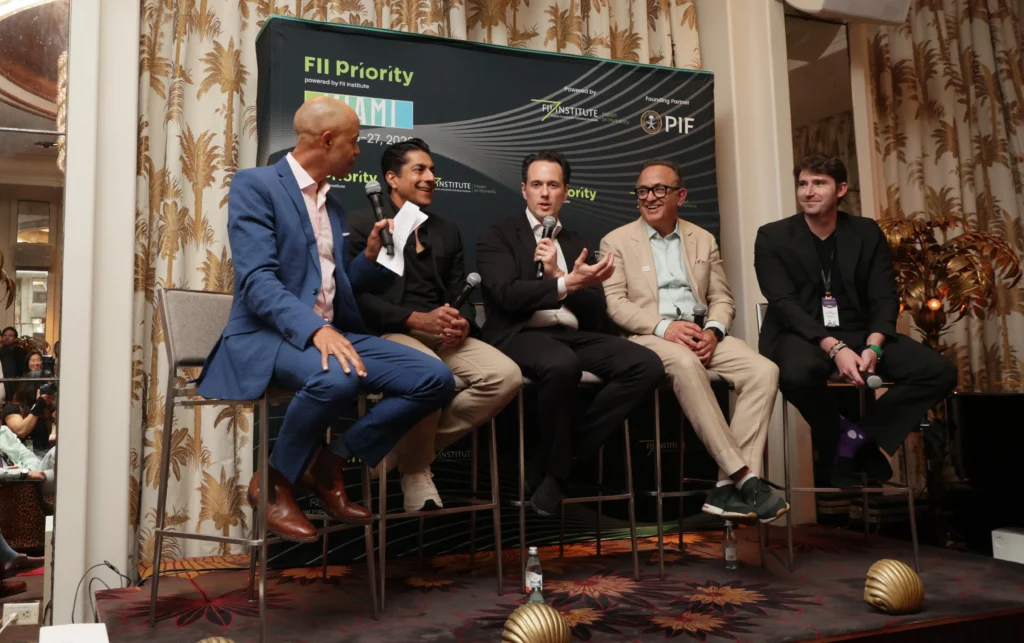
The discussion on AI agents made clear that the limiting factor is no longer model performance, but adoption inside real-world systems.
While AI tools are widely used at the consumer level, enterprise deployment remains significantly slower. The challenge lies in precision, accountability and trust, particularly in sectors such as finance, where errors carry material risk.
This gap between capability and deployment signals a transition: AI is moving from experimentation into environments where reliability, governance, and integration matter as much as performance.
Physical AI: Scale requires systems

In the session on robotics and physical AI, speakers emphasized that competitive advantage will not come from a single factor.
Ibrahim Neyaz, CEO of Saudi Arabia’s National Technology Development Program, stated that the physical AI race will be won by those who can create a reliable environment for it.
“To win the race in the physical AI, you have to create an integrated ecosystem where you combine the research with the manufacturing and the capital… none of them alone can win”, Neyaz said.
The implication is structural, according to the speakers: value is created not at the level of individual technologies, but in environments where they can be deployed, tested, and scaled continuously.
Countries are already differentiating along these lines, with strengths split between innovation, manufacturing, and deployment capacity.
Energy: The system behind the system
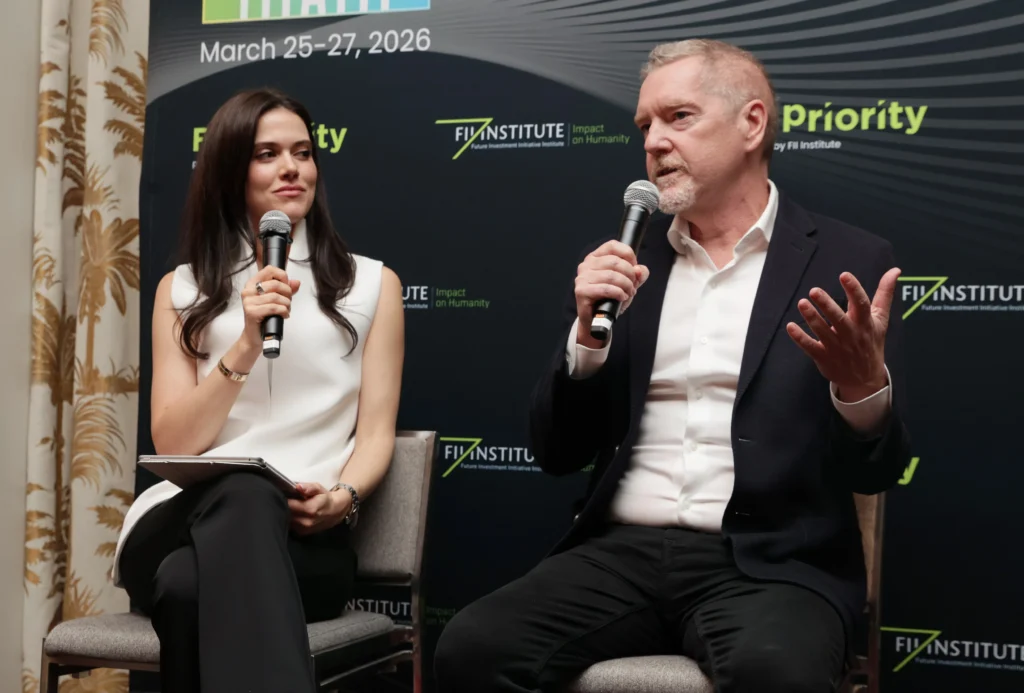
The most direct constraint identified across sessions was energy.
Peter Barrett, General Partner at Playground Global, described it in systemic terms.
“I actually don’t think we’re in a bubble. If anything, we are underestimating the build out that’s going to be required to meet humanity’s demands for computation”, he said.
His argument was clear: AI cannot scale independently of the infrastructure that powers it. The challenge is not limited to generation, but includes transmission, efficiency, and how energy is used within computation itself.

According to FII Institute’s Public-Private Partnerships: Financing the Future Impact report (2026), the global infrastructure financing gap is estimated at $15 trillion by 2040, a shortfall that makes private capital not just relevant but essential to meeting the demands of the next wave of technological deployment.
Beyond Earth: Expanding infrastructure

The final session extended this logic further, examining space as a potential extension of industrial capacity.
Speakers pointed to constraints on Earth, including energy limitations and long permitting timelines, as drivers for exploring alternatives.
Jim Keravala, Founder and CEO of OffWorld, argued:
“We cannot move forward without opening up into the space domain. We are now talking about tens of terawatts of power… You cannot do that on the planet and maintain environmental stability. We have to go out into space.”
His argument positioned space not as a distant frontier, but as a necessary expansion: sustained exponential demand for compute and energy will require new domains of deployment.
A shift in focus
Taken together, the sessions pointed to a shift in how AI is understood.
The first phase was defined by building models. The next phase will be defined by deploying them in trusted environments, scaling them through physical systems, powering them with sufficient energy and, potentially, extending infrastructure beyond traditional limits.
The central question is no longer what AI can do, but whether the systems around it can support what comes next.
Produced by FII Institute Editorial Team