
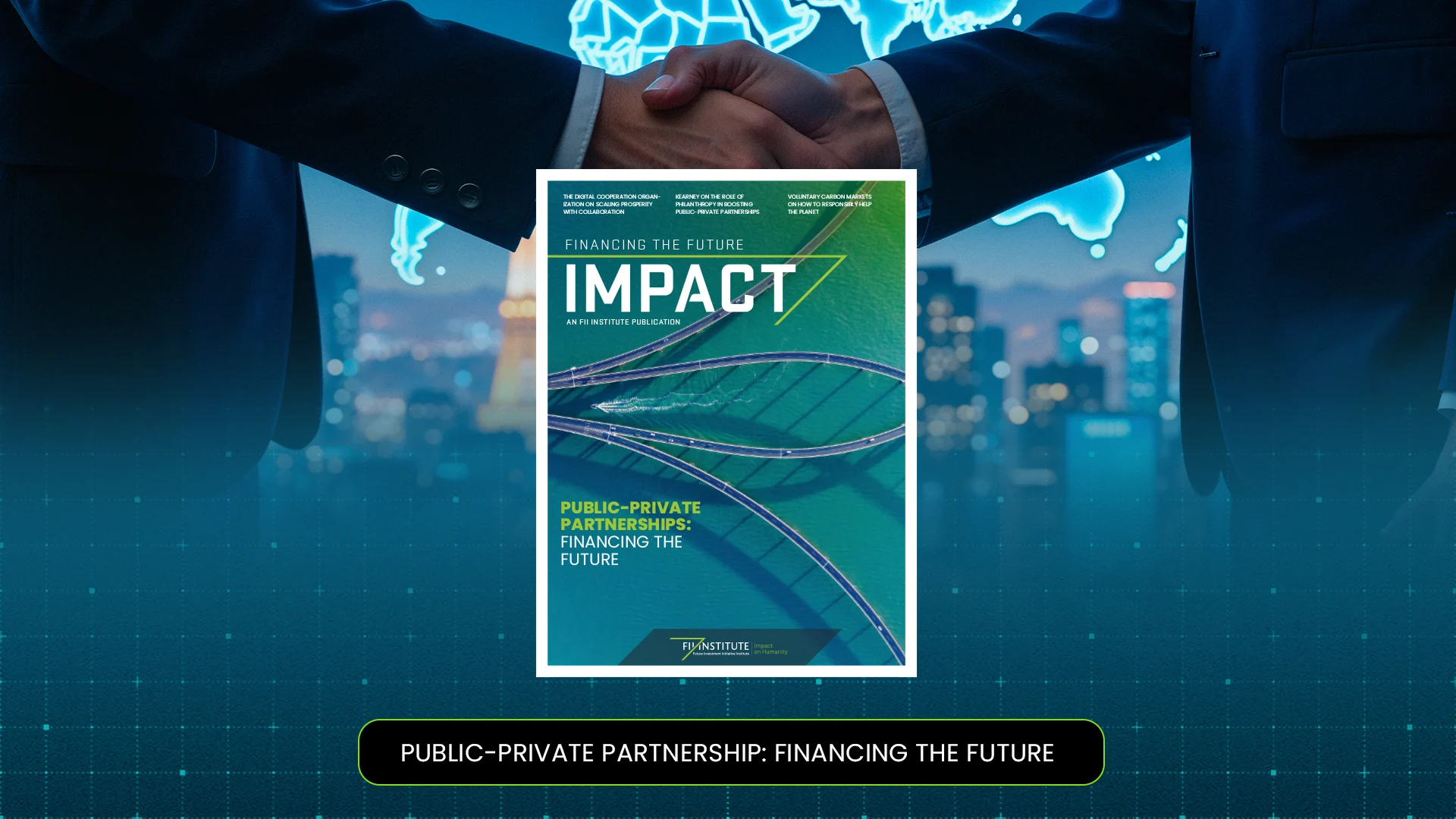
RIYADH, Saudi Arabia, February 10, 2026 – A new FII Institute Impact Report developed in collaboration with the Digital Cooperation Organization (DCO), Kearney, and Voluntary Carbon Market Company (VCM), argues that the ability to deliver resilient infrastructure, expand digital connectivity and accelerate the energy transition will increasingly depend on the strength and legitimacy of public-private partnerships (PPPs), as fiscal space tightens and investment needs rise.
The report estimates a USD 15 trillion global infrastructure financing gap by 2040. It also points to significant regional shortfalls, including an estimated USD 3.7 trillion gap in the United States and an annual USD 130–170 billion gap across Africa. In this context, PPPs are moving from a transactional procurement route to a central model for financing and delivery.
Emerging markets are driving the next wave of PPP growth. PPP spending across low-and middle-income countries reached USD 100.7 billion in 2024, up 16% year-on-year. The report also notes that emerging markets now represent around 61% of global PPP activity by GDP share.
Project pipelines reinforce this shift in the center of gravity away from traditional hubs. The Philippines leads the emerging-market pipeline with 230 projects, followed by Saudi Arabia with 98, Kyrgyzstan with 80, Bangladesh with 71, and Peru with 54 projects.
The report cites evidence linking well-designed PPPs to stronger user outcomes, including reported satisfaction levels of 83% for PPP projects compared with 69% for non-PPP projects.
However, it stresses that capital is not the only constraint. Public consent is becoming decisive. Across seven countries, only 23% of citizens agree that PPPs “equally benefit everyone”, compared with 41% of business and government leaders.
To move from projects to systems, the report calls for clearer risk-sharing, transparent contracting and outcome-based metrics that track resilience, service quality, and emissions.
It also points to blended finance to make high-impact but high-risk projects investable, citing MUFG’s USD 1.48 billion Project GAIA finance platform, which uses concessional capital to unlock climate adaptation projects across 25 emerging markets, with around 70% directed to climate-resilient infrastructure.
The report concludes that closing the infrastructure gap will require aligned public mandates, investable structures, and visible benefits for communities, enabling PPPs to act as engines of inclusive, resilient growth.
Read the report on our website: https://fii-institute.org/publication/financing-the-future-impact-report-2026
-ends-
About the FII Institute
The FII Institute is a global nonprofit foundation with an investment arm and one agenda: Impact on Humanity. Through its THINK, XCHANGE, and ACT pillars, the Institute fosters great ideas, empowers innovators, and invests in scalable solutions across critical sectors, including AI and robotics, sustainability, healthcare, and education.
For more information, please visit: https://fii-institute.org/
For media inquiries, please contact media@fii-institute.org.