The issue at stake: Home offices are far more sustainable than office-offices, we were told during the pandemic. But how much resources does working from home really save? And how sustainable will our post-COVID office-mix be?
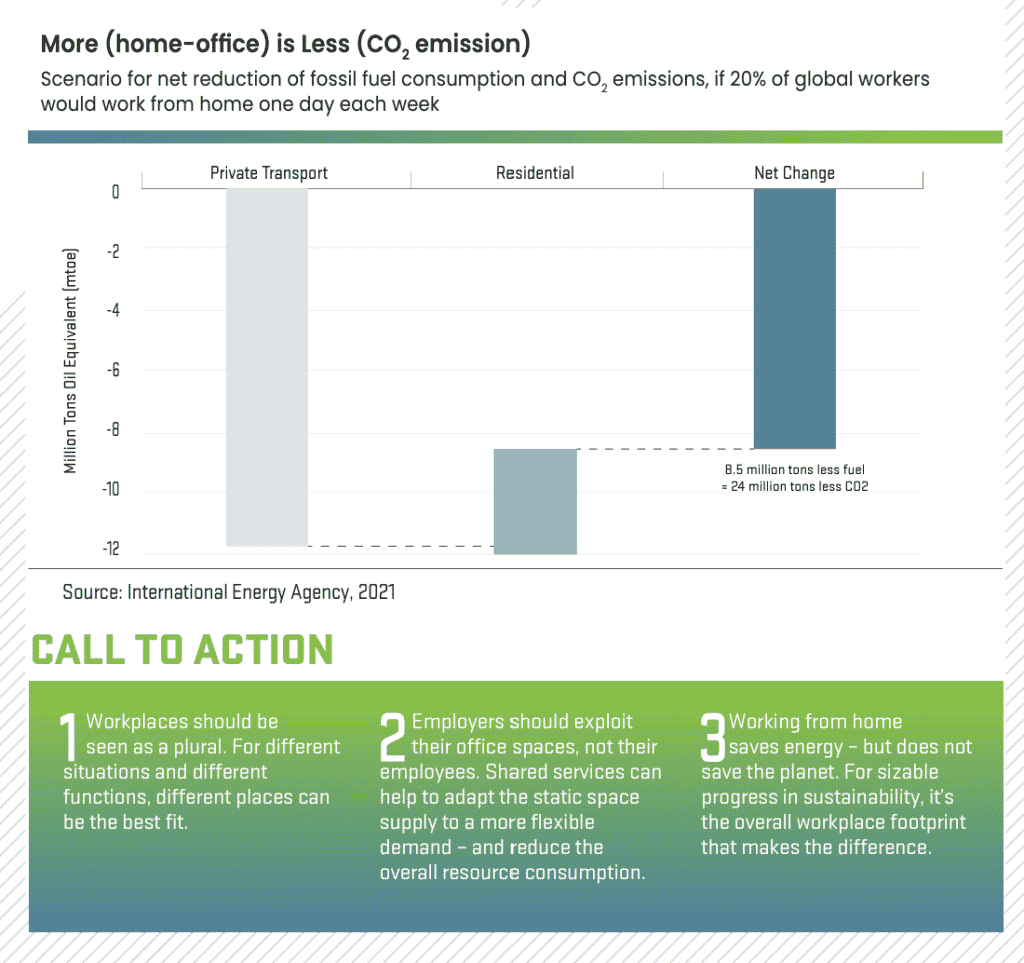
2020 smashed all the records. Almost two billion tons less CO2 production than in the year before, a decrease of 5.4 % of global CO2 emissions, mostly due to the economic shock waves of the COVID-19 pandemic – unprecedented! But though the virus raged on, the CO2 did not: according to Global Carbon Project, global emissions rose in 2021 by 4.9 %, an almost total rebound. But didn’t we change our behavior massively, and continue to do so? Less trade fairs and business travel, more online shopping and home office – a lot of changes that were induced by the global lockdown period in early 2020 are here to stay; and all of them should reduce the resource intensity of our lifestyle and workstyle. Let’s just look at our workplaces. A higher percentage of home-office work will lead to less commuting and less fuel consumption, so it must yield environmental benefits. Yes, it does, as many studies found out. The US e-Commerce company Shopify for example calculated, that letting all its 6000 employees work from home since 2020 reduced their energy consumption by a whopping 29 % per year. Other studies though, had more sobering results, like the one of the International Energy Agency IEA (see chart). For its scenario, the IEA assumed that 20% of all workers on the globe would do one day of home-office each week. The reduction of transportation energy was partly offset by higher energy consumption at home, eg. for office equipment or air-condition. The net result: overall energy use falls by around 8.5 million tons of oil equivalent, leading to a drop of 24 million tons in annual CO2 emissions.