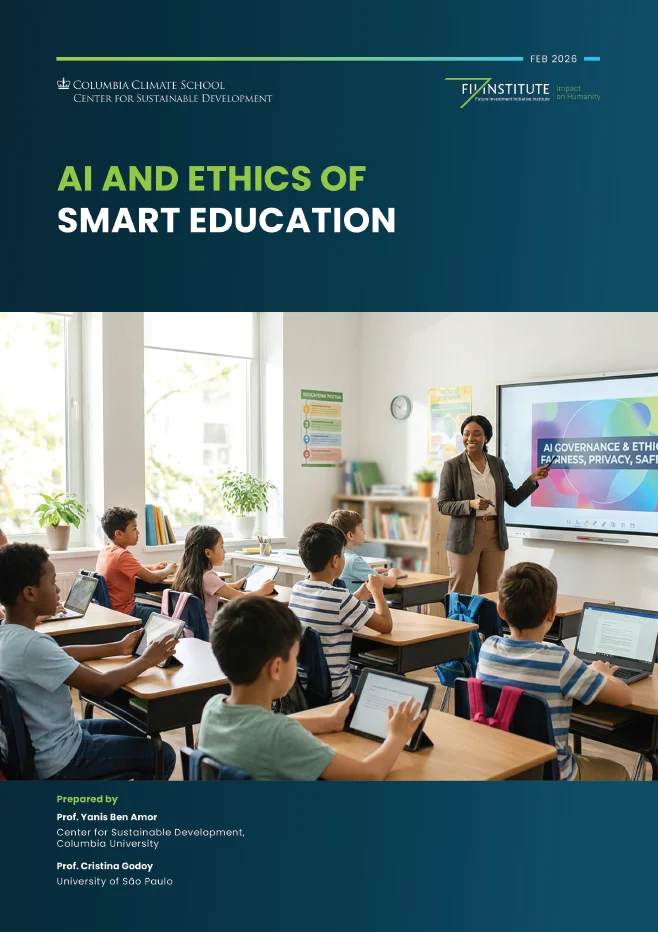
Can artificial intelligence truly transform education without compromising the rights, safety, and futures of children?
FII Institute’s latest report on AI and the ethics of smart education, in collaboration with Professor Yanis Ben Amor (Center for Sustainable Development, Columbia University) and Cristina Goday (University of São Paulo), examines how artificial intelligence, learning analytics, and generative AI are reshaping classrooms across the European Union (France), Qatar, Brazil, China, Japan, and the United States.
While AI-powered education technologies promise personalized learning, accessibility, teacher support, and data-driven system planning, the report warns that schools concentrate some of the highest-risk AI applications, ranging from longitudinal student profiling and automated assessment to generative AI tutoring and biometric surveillance. Through a comparative global lens, the analysis reveals the governance models, ethical tensions, and emerging policy questions defining the future of AI in schools, addressing data protection, child safety, generative AI risks, equity, infrastructure, and human oversight. It offers a forward-looking framework to guide policymakers, educators, and technology leaders in building trusted, ethical, and future-ready smart education systems.