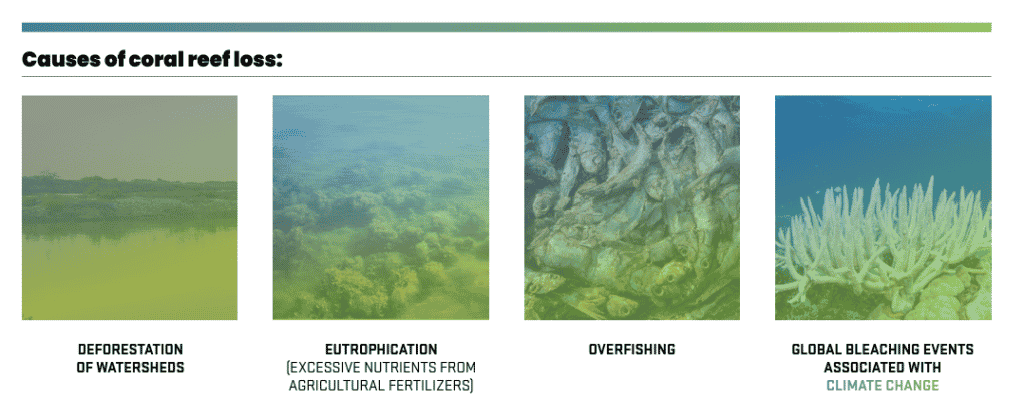
ABOUT TWO-THIRDS OF THE GLOBAL extent of tropical coral reefs has already been lost – 14 percent of that in the last decade alone, largely as a result of climate change. Even if we reach the most ambitious goal of the Paris Agreement, 75–90 percent of those remaining are projected to disappear by 2035. Securing a future for coral reefs requires an all-hands-on-deck effort. We must mobilize scientists, technologists, innovators, policymakers and philanthropists. We need to develop and deploy at scale the next generation technologies and science that will enable us to conserve and restore coral reefs.
RAINFOREST OF THE OCEAN, FIRST LINE OF DEFENSE OF TROPICAL SHORELINES Tropical coral reefs are remarkable components of the world’s oceans. They harbor one in every three species of named marine animals – an estimated 1 million marine species – and build the largest structures produced by any species on Earth. They are tropical shores’ first line of defense against storms and cyclones, reducing damage from coastal storm flooding by over 50 percent.1 They also support the livelihoods of over 600 million people in the tropics. In 2002, when a maximum was reached, coral reefs supported 2 percent of global fishery catches, driven by artisanal fisheries involving an estimated 6 million fishers, mostly from developing nations.2 Coral reefs are complex three-dimensional structures that form from the growth of coral colonies through the calcium carbonate that they deposit. Their polyps divide colonially to increase the size of their colonies, which coalesce with neighboring colonies to form reef structures that slowly grow over thousands of years, at rates of a few millimeters per year. Most of the coral reefs that exist today have developed over the past 5,000 years. There are individual living colonies that are several centuries old. These reefs dissipate wave energy and protect adjacent shorelines, typically producing a calm lagoon where seagrass and mangroves grow. The three-dimensional complex structures that coral reefs produce provide habitat and refugia for many organisms. The most diverse coral reefs are those in the Coral Triangle, which includes the waters of Indonesia, Malaysia, the Philippines, Papua New Guinea, Timor-Leste and Solomon Islands. The Coral Triangle has the oldest seafloor in the ocean and supports the highest species diversity in the marine environment, including 600 different species of reef-building corals alone.
By CARLOS M. DUARTE
Executive Director, Global Coral Reef R&D Platform, and Distinguished Professor and Tarek Ahmed Juffali Research Chair in Red Sea Ecology, King Abdullah University of Science and Technology.