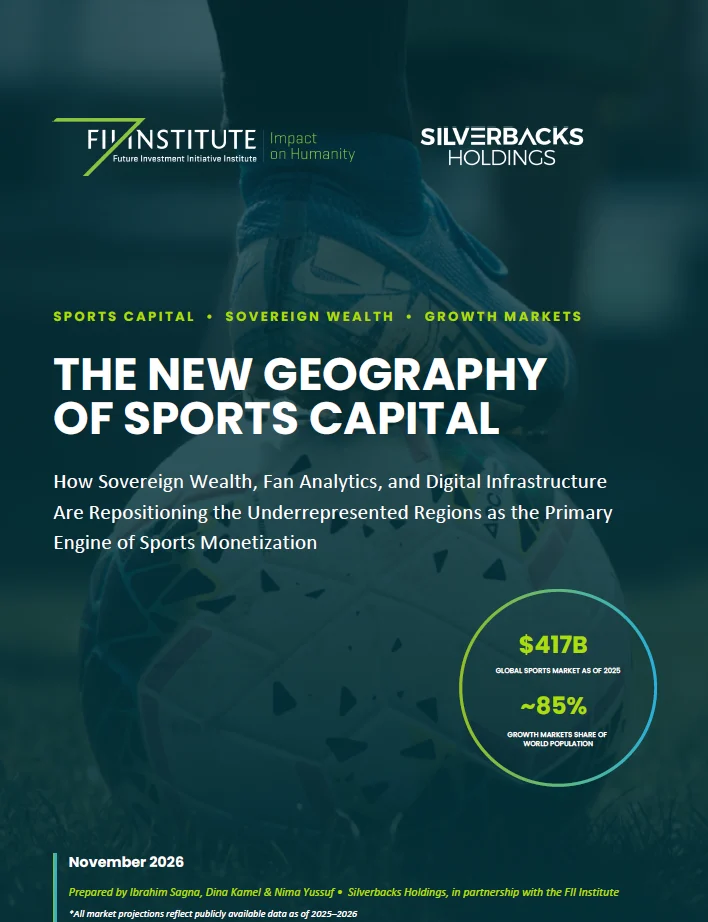
Global sports capital is going through its biggest geographic shift since football became a commercial business in the 1990s. Growth Markets across the GCC, Africa, Asia-Pacific and Latin America are home to around 85% of the world’s population and about 42% of global GDP. Yet they still own only a small share of the world’s sports IP, media rights and institutional capital. Western Markets remain the benchmark, but they no longer have a monopoly on sports growth.
The New Geography of Sports Capital is a white paper by Silverbacks Holdings in partnership with the FII Institute. It argues that this imbalance is itself the investment case. The core global sports market was worth an estimated $417 billion in 2025 and is projected to reach $602 billion by 2030. Within that market, the paper shows how sovereign capital, mobile-first fan ecosystems and the institutionalization of domestic leagues are turning Growth Markets into places that create durable, investable sports assets.
The report draws on examples from India’s $18.5 billion Indian Premier League (IPL), Saudi Arabia’s Vision 2030 sports strategy, Brazil’s SAF club reforms, and Egypt’s emerging fan-tech and club-listing ecosystem. It looks at sports as economic soft infrastructure, the gap between technology and analytics that separates fan engagement from commercial yield, the rise of athlete-investors, and e-sports and mobile gaming as a new distribution layer. It ends with a four-principle investment playbook for sovereign wealth funds, private equity firms and institutional allocators who want to position early in the decade ahead.
Authors